
Every era is defined by the problems it chooses to solve. The next one may be defined by who gets to solve them.
For too long, the world looked at Africa through the language of shortage: too little power, too little investment, too little access. Yet the people closest to those challenges have been building answers of their own. In Kenya, discarded plastic becomes an industrial feedstock. Across borders, a new benchmark makes technology companies easier to see. In the diaspora, a filmmaker makes East London a setting for a global drama.
The measure of innovation is what it makes possible for other people.
These are different kinds of enterprise. They share a belief that ingenuity becomes meaningful when it reaches beyond the inventor. Some are established, some are growing, and some claims still require proof. All ask us to look more carefully at where the world’s next ideas will come from.
From waste to work: James Muritu, Kenya
Where others saw a pile of unwanted plastic, James Muritu saw an industrial input. In Murang’a County, his company ProGreen Innovations uses pyrolysis: heating certain plastics without oxygen to break them into hydrocarbon products that can be refined for use as fuel.
The process does not make energy from nothing, nor does burning the resulting fuel eliminate emissions. Its promise is more practical: recovering value from waste that might otherwise accumulate in streets, waterways or landfill. ProGreen also works on building materials and other waste-derived products. The company says its alternative fuels are certified in Kenya; the scale, economics and environmental impact of expansion will matter as much as the prototype.
Muritu’s idea begins with a question every city understands: what if a costly burden could become useful work? A local answer can create another kind of momentum—for collectors, technicians, manufacturers and the people who depend on affordable energy.
Water from the air: Moses West, United States
A machine that makes drinking water from humid air sounds like a conjuring trick. The physics is familiar: air is cooled until its moisture condenses, then the water is filtered and treated. The engineering challenge is to do it reliably, efficiently and at the scale communities need.
After serving in the US Army, Moses West made that challenge his mission. His foundation describes atmospheric water generators deployed in Flint, Puerto Rico, the Bahamas and other places where ordinary water systems failed or were disrupted. It reports more than four million gallons produced globally; that total is the foundation’s own figure.
The machines still need power, suitable humidity and maintenance. They are one tool in water resilience, rather than a substitute for good public infrastructure. But when a crisis breaks the usual supply chain, being able to produce water close to the people who need it can change the first hours of a response. West’s guiding question is elegantly human: why should clean water have to wait for a delivery truck?

Capital needs a clear line of sight: Gbite Oduneye and AT50
There is a quiet injustice in a promising business that can find customers but cannot be seen clearly by the capital markets. Information is uneven, comparisons are difficult and ambition is too often judged through someone else’s map.
Gbite Oduneye has helped build a different map. On 28 January 2026, the London Stock Exchange hosted the launch of the Africa Tech 50, or AT50, an index of private African technology companies assessed for their readiness to enter public markets. Its organiser, Indexa Exchange Group, says the benchmark considers revenue strength, governance, expansion and other signals, with quarterly reviews. A Johannesburg exchange activation followed in July.
An index cannot fund a founder by itself, and AT50 is a benchmark rather than a fund available to buy. What it can do is give investors, exchanges and advisers a shared language for businesses that have too often been discussed as isolated exceptions. Visibility is infrastructure. Once the market can see a field, it can begin to price it more intelligently.
The breakthrough here is not a machine. It is the possibility of building a better bridge between African enterprise and global capital.
Whose stories travel: Sebastian Thiel and Fightland
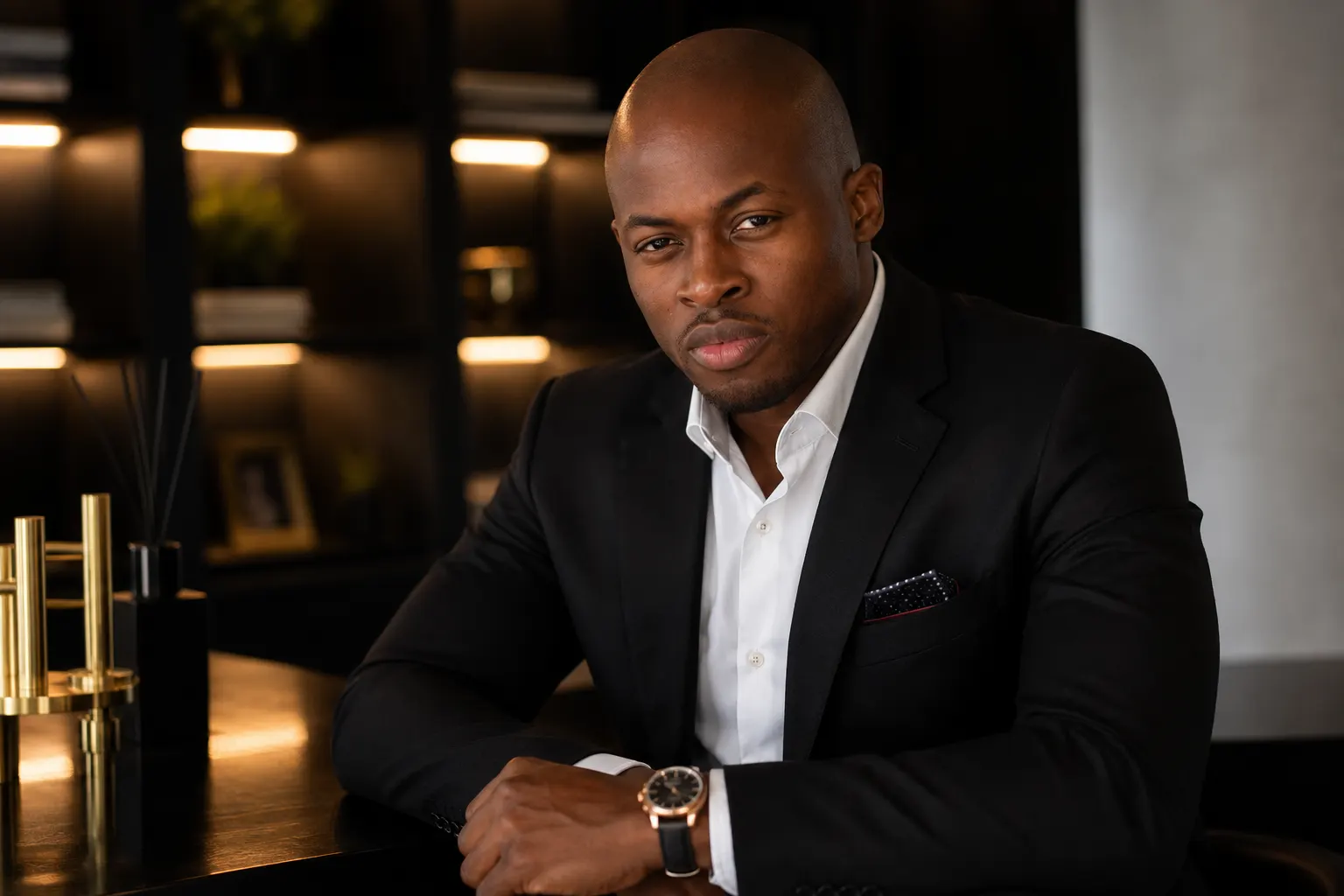
Innovation also changes who gets the camera, the commission and the international audience. Sebastian Thiel knows what it means to belong to more than one place. Born in Zambia and raised in North West London, the director, writer and producer has built a career making room for Black stories with the scale and texture they deserve.
He founded Upshot Entertainment as a teenager to make the work he wanted to see. What began with self-produced films and online audiences led to television, including Dreaming Whilst Black and Riches. He went on to direct episodes of Netflix’s Supacell, a superhero story rooted in contemporary London. Now Fightland, the boxing drama on Starz, brings another London story to an international screen. Thiel is among its directors; its cast includes Howard Charles, Deborah Ayorinde and Nicholas Pinnock.
That journey across continents and communities gives his work a particular eye for movement, ambition and belonging. His direction has the energy of someone who understands that a neighbourhood can be a whole world—and that its stories can travel far beyond it.
One series cannot stand for an entire diaspora. It can widen the space in which Black British artists work at scale. When local experience travels without losing its character, the next generation sees a path from its own streets to the world stage. Cultural ownership is an innovation of its own.

The ambition—and the proof: Maxwell Chikumbutso, Zimbabwe
Sangulani Maxwell Chikumbutso has attracted attention with a dramatic proposition: vehicles powered by a device he says harvests ambient radio waves. His ambition speaks to a genuine desire for locally developed answers to energy insecurity.
In February 2025, the Harare Institute of Technology announced a partnership with his company, Saith Technologies, that includes scientific advice and pilot testing. That announcement is not a published independent validation of the vehicle’s performance. Ambient radio waves carry far too little power to propel a car as claimed, and no credible public test has established otherwise.
Belief can bring an inventor to the laboratory door. Transparent measurement must carry an invention through it. Africa’s innovators deserve the same rigorous testing, investment and honest recognition as innovators anywhere else. That is how a bold idea becomes one the world can trust.
The new narrative belongs to its makers
Fuel recovered from waste. Water produced near a crisis. Capital made more legible. Stories that cross oceans. These are not one neat category called “African innovation”. They are people working in different places, with different tools, for different communities.
There is no need to pretend every experiment is complete, or that every enterprise has solved the problem it set out to face. The more compelling truth is that initiative is already here. Talent is testing, building, failing, improving and trying again. The diaspora is part of that movement, connecting insight and opportunity in both directions.
Africa is beyond the limits of an old narrative because its people are writing new ones. The strongest ideas will be measured by evidence, by durability and, in the end, by the lives they help lift. That is progress worth pursuing.


Sources
- ProGreen Innovations: products and process
- Kenya News Agency: James Muritu and plastic-derived fuel
- Moses West Foundation: deployments and reported output
- London Stock Exchange: launch of AT50
- Indexa Exchange Group: AT50 methodology and markets
- Starz: Fightland series and credits
- Sebastian Thiel: official biography and credits
- Netflix: Supacell production and directing credits
- Harare Institute of Technology: Saith partnership and proposed testing