
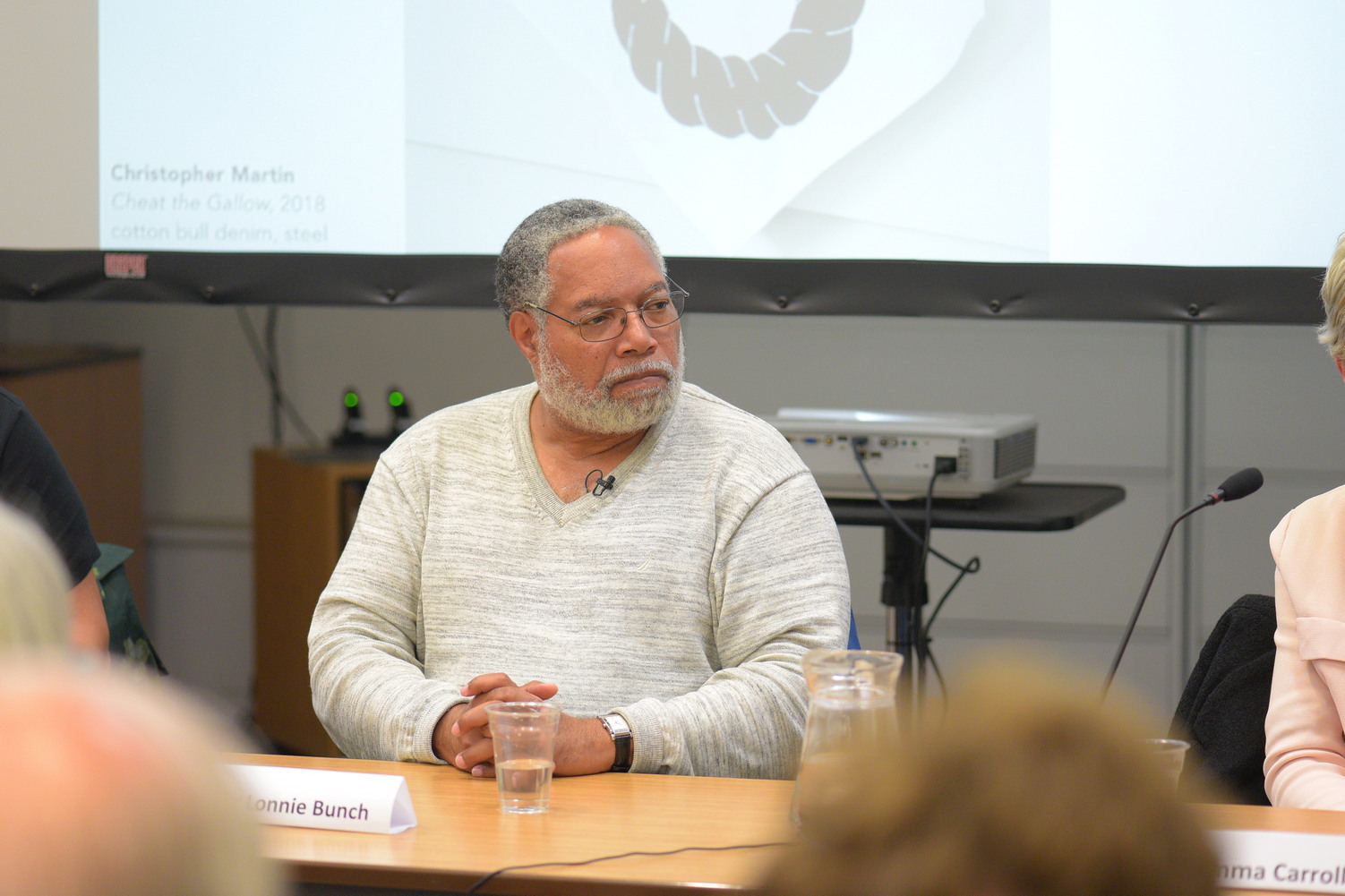
Some leaders inherit institutions. Others remake them.
When Joseph Farodoye first sat down with Lonnie Bunch in 2022, the 14th Secretary of the Smithsonian was three years into the job and already tested in ways few predecessors had been. Four years on, he has announced that he will step down at the end of 2026. He leaves after nearly 38 years at the institution, and as the first historian and first African American to lead it.
His story is not one of easy ascent. It is a story of beginnings with nothing, doors forced shut, and a steady refusal to let history be made smaller than it is.
One Desk, No Collection, No Building
Nearly fifty years ago, a 25-year-old historian was hired at the National Air and Space Museum by its director, Apollo 11 astronaut Michael Collins. Asked what Collins saw in him, Bunch has said simply that it was probably passion.
That passion would be tested. In July 2005, Bunch became founding director of the National Museum of African American History and Culture. He had one member of staff. He had no collection, no funding and no site. Many would have called it a fool's errand, and he later used exactly those words as the title of his book about it.
What turned the errand into a triumph was not money alone. It was belief, and Bunch had a rare gift for inspiring it. His conviction and integrity drew in supporters from every walk of life, many from well beyond the usual circles of museum patronage.
The most famous names in American life answered his call. Oprah Winfrey gave $21 million. Basketball legend Michael Jordan and BET founder Robert L. Johnson each gave more than $5 million, and financier Robert F. Smith gave $20 million (Los Angeles Sentinel). President Barack Obama spoke at the groundbreaking in 2012, and he and First Lady Michelle Obama led the dedication in 2016 alongside former President George W. Bush (Smithsonian).
The movement reached far beyond the famous. Of the $500 million needed to build the museum, $265 million came from private giving. Three quarters of the donors who gave $1 million or more were African American (Philanthropy Roundtable). Alfred Street Baptist Church in Virginia gave $1 million, with members contributing anything from 50 cents upwards. Before a single door opened, more than 100,000 people had signed up as members, the largest member base of any Smithsonian museum.
Bunch did not simply raise funds. He built a sense of ownership, a feeling across the country that this museum belonged to everyone who had helped make it.
Eleven years later, in September 2016, the museum opened on the National Mall to near-universal acclaim. It has since welcomed more than 13 million visitors, holds 40,000 objects, and occupies the first ‘green building’ on the Mall. In 2019 its creation became the first Smithsonian effort to be studied as a Harvard Business Review case study.
That same year, on 16 June 2019, Bunch became Secretary of the entire Smithsonian. He was the first historian to hold the role, and the first African American in its history. At his installation, he spoke of Frederick Douglass, who could not have spoken in that place, and signalled that he would never be afraid to tell truthful stories.
The Year the Doors Closed
Nine months into his tenure, the unthinkable happened. On 14 March 2020, every Smithsonian museum and the National Zoo closed to the public.
An institution that had welcomed 22.1 million visits the year before fell to 3.3 million in 2020 (Smithsonian). Shops, cafés and the revenue they brought fell silent. For a new Secretary, it was a test of leadership no manual had prepared for.
Bunch had already moved before the crisis hit. Just weeks earlier, on 25 February 2020, the Smithsonian released 2.8 million images and data into the public domain. Anyone in the world could now download, share and reuse its treasures for free, for any purpose. It was the largest open access programme of any cultural institution at the time (Smithsonian). When the buildings closed, the collection was already out in the world.
He used the shutdown to ask a harder question: how the Smithsonian could become ‘a more 21st-century organization’ (WTOP). Education portals grew online. The institution rethought how it earned money, expanding e-commerce as its shops stood empty. Reopening followed the science, with free timed-entry passes to keep crowds safe and museums returning one by one.
By the summer of 2021 the whole Smithsonian had reopened, and on 20 July most museums returned to walk-up visits (Smithsonian). The recovery that followed was remarkable. Visits climbed more than fivefold, from 3.3 million in 2020 to 17.7 million in 2023.
The pandemic closed the doors. His innovation made sure the Smithsonian never stopped being open.
The Truth in Difficult Times
If Covid tested his leadership, the years that followed tested his conviction.
Museums across the world now work under a spotlight. What they display, and how they tell a nation's story, has become a matter of public and political debate. The Smithsonian, as America's national museum, has stood closer to that light than any other. Bunch met the scrutiny the way he has met every challenge: calmly, and without retreating from the evidence.
His belief is simple. A nation that knows only half its story is incomplete. He has compared it to a visit to the doctor where you ask to hear only half of the results. ‘You can run from history,’ he says, ‘but you can't hide.’
That is not the language of a partisan. It is the language of a patriot and a historian. The son of a Second World War veteran, Bunch grew up with Memorial Day parades. He asks the nation to love itself enough to look at the whole picture. His guiding idea for the Smithsonian is that it is America's collective memory, and a nation should not choose to forget.
To hold that line with grace, year after year, is its own kind of excellence.

A Legacy Written in Open Doors
Measure Lonnie Bunch by what he leaves, and the list is extraordinary.
He built a national museum from a single desk. He guided 21 museums, the National Zoo and 20 libraries through the greatest closure in their history, then brought the visitors back. He opened millions of images from the collections to anyone, anywhere, for free. He led the largest capital campaign of any cultural institution, passing its $2.5 billion goal. And he carried forward two new museums approved by Congress: the National Museum of the American Latino and the Smithsonian American Women's History Museum (Smithsonian).
On 8 September 2026 he announced his retirement, saying he leaves ‘with pride and sadness, gratitude and joy’. He has called the Smithsonian one of the great loves of his life. Asked what he is proudest of, he does not hesitate. It is the museum that tells ‘a people's journey, but a nation's story.’
Great institutions outlast the people who lead them. The best leaders make sure they are worth outlasting. At the end of 2026, the Smithsonian will pass to new hands, stronger, more open and more honest than he found it.
The keeper of the truth is stepping down. The truth he kept will remain.